
Blog posts tagged "Cloud Native"

Telecommunications networks are undergoing a cloud-native revolution. 5G promises ultra-fast connectivity and real-time services, but achieving those benefits requires an infrastructure that is agile, low-latency, and highly reliable. Kubernetes has emerged as a cornerstone for telecom operators to meet 5G demands. In 2025, Canonical Kube

It’s hard to believe that the first KubeCon took place nearly 10 years ago. Back then, Kubernetes was still in its early days, and the world was only just beginning to understand the power of container orchestration. Fast-forward to today, and Kubernetes is a fundamental part of cloud-native development, taught in universities as a key

Introducing trusted open source database containers It’s time to stop proclaiming that “cloud native is the future”. Kubernetes has just celebrated its 10 year anniversary, and 76% of respondents to the latest CNCF Annual Survey reported that they have adopted cloud native technologies, like containers, for much or all of their productio
Why should you use an official distribution of Kubeflow? Kubeflow is an open source MLOps platform that is designed to enable organizations to scale their ML initiatives and automate their workloads. It is a cloud-native solution that helps developers run the entire machine learning lifecycle within a single solution on Kubernetes. It can
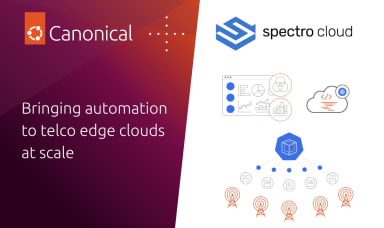
Canonical and Spectro Cloud have collaborated to develop an effective and composable telco edge cloud solution, which is built with Canonical’s open source infrastructure solutions and Spectro Cloud’s Palette containers-as-a-service (CaaS) platform. This technology stack empowers operators to benefit from the cost optimisation and agility

Date: 17-21 April 2023 Location: Amsterdam Booth: P15 In just a few weeks, Kubecon will be held at RAI Convention Center, in Amsterdam, the Netherlands. After a bunch of news from the industry around AI projects, such as GPT4 or MidJourney4, Canonical is also ready to bring open source into the landscape. Among the attendees,

Canonical, the publishers of Ubuntu, will have a strong presence at this year’s KubeCon + CloudNativeCon Europe as a platinum sponsor. The Cloud Native Computing Foundation’s flagship will once again bring together adopters and technologists from leading open-source and cloud-native communities worldwide to meet in Amsterdam, Netherlands,

Large enterprises usually have more than 1,000 systems running. Even smaller organisations may have hundreds of applications in their public cloud spaces or on their servers. In this world of IT systems, application migrations are common for the following reasons: At some point, software reaches its end of life and is not supported anymor
By operating cloud workloads with Charmed OSM, VMO2 will benefit from increased agility and scalability, as well as an optimised migration to network functions virtualization (NFV). A new approach to service lifecycle management in telco The challenge of network hosting in telco clouds and the desire to shift service management to more au

Canonical has conducted surveys about Kubernetes and Cloud Native Operations in the past two years. As a member of the Cloud Native Computing Foundation (CNCF) and an active part of the community, we contribute the anonymised results back, along with our analyses and the insights of industry experts. Everyone can submit an answer anonymou

Date: October 26-27 2022 Where: CloudExpo Madrid, IFEMA Madrid CloudExpo Madrid is an important event in the Iberian peninsula that brings together exciting topics from the tech world: from cloud to security and from digital transformation to task automation. Canonical is happy to attend this year and talk about Kubernetes and its succes
The 5th Operator Day is coming up. It will take place at KubeCon North America 2022. This edition will center on cases where software operators have been applied successfully. Join us to hear about our experience in building software operators using Juju, an open-source operator lifecycle manager. Operators implemented for Juju are called

Running or operating applications requires several tasks throughout their lifecycle: scaling instances, checking the health, integrating with other applications, running backups, and applying updates – to name a few examples. It’s a time and labour-intensive process. To automate these tasks, developers can implement scripts for repeated e

Canonical, the publisher of Ubuntu, joined ULAP.org in their cloud-native computing upskilling and career development initiative held in Dewise office in Manila, Philippines, last June. ULAP’s mission is to help underrepresented STEM students kickstart a career in cloud, data, and technology. Michelle Anne Tabirao, Data Solutions Product

The software operator is a design pattern – it is a proven design that has been applied in many situations and implemented by several frameworks. Its widespread adoption in the industry has allowed us to study its consequences, both good and bad. This is important because software developers and IT architects need to know when

The software operator is a design pattern. Its design is based on successful applications where this approach was found useful. In other words, it’s a proven approach that can be recommended to others. But like all approaches, it’s important to understand their positive and negative impact. Software developers need to understand when the